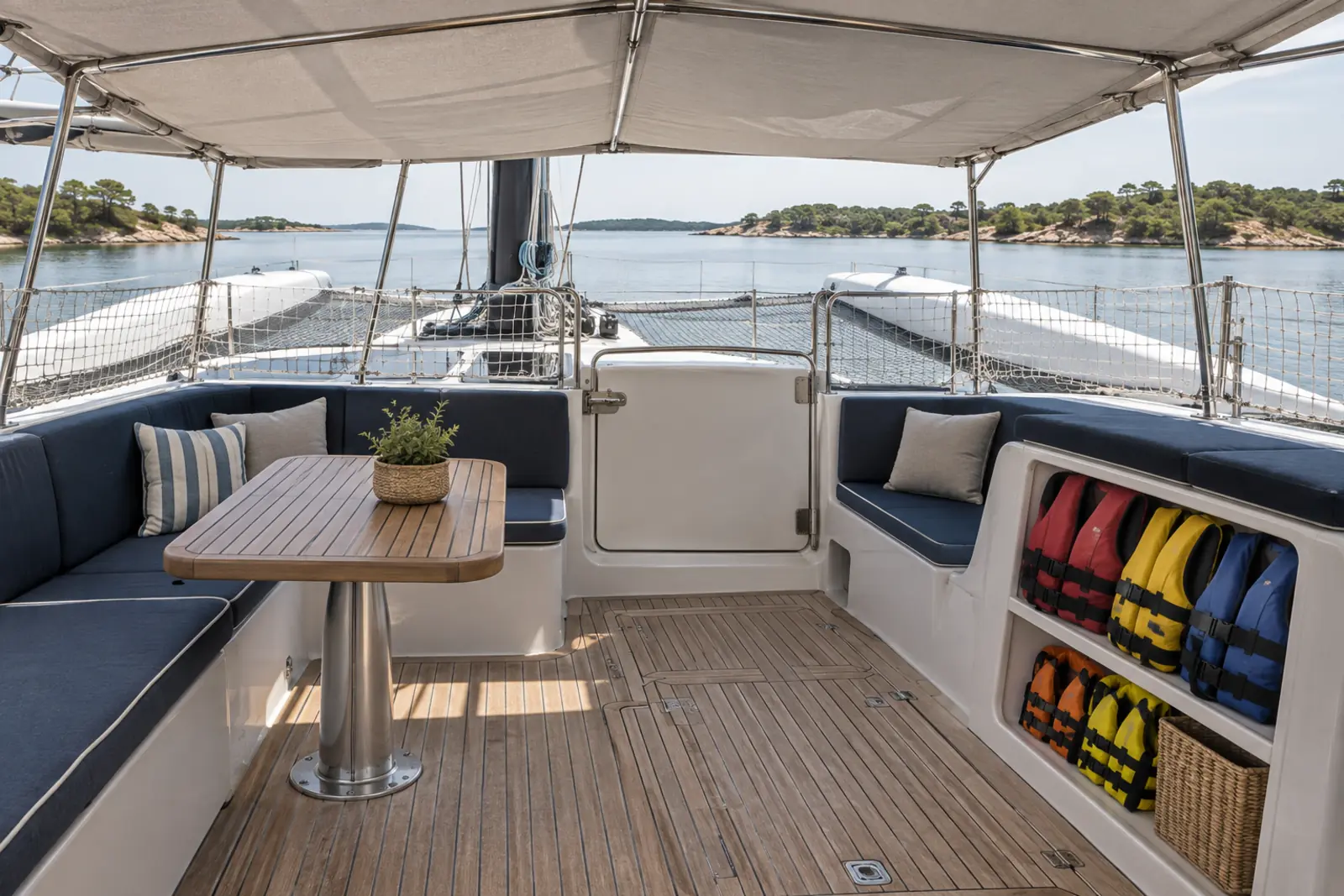
A good family charter yacht does two things at once: it keeps everyone comfortable on the water, and it gives enough private space that nobody feels they are sleeping in a hotel corridor. A super trimaran can do both, because three hulls spread across a wide beam give a stable platform, plenty of outdoor space and a natural separation of cabins. This guide explains what to look for if you are considering one for a family week afloat, how the safety questions work, which destinations suit children, and what to ask a charter broker.
Why Three Hulls Matter for Families
The motion of a sailing yacht is the first thing non-sailors notice, and often what ends the enjoyment of a child who was excited on the dock. A monohull heels under sail and can roll at anchor. A catamaran is steadier, with two hulls, but it can still pitch in a short chop. A trimaran spreads its buoyancy over three hulls and a wide platform, and usually heels much less than a monohull in moderate conditions. Children can generally move around the deck and eat meals without gripping anything for balance. No yacht is motion-free in rough water, so check the forecast and the itinerary with the captain.
The second advantage is usable area. Many trimarans use the central hull for the main living and sleeping spaces, while the outer hulls carry additional cabins, storage or crew quarters. Outdoors, the central deck can hold sunbeds and a large dining table, and many designs include wide trampoline netting forward where younger children often spend much of the day. Compare real deck plans, because the layout varies widely between builders.
Speed is a third factor. Parents of young children know that long, slow passages wear down morale. A performance sailing trimaran can cover island-to-island distances faster than many monohulls, which means shorter passages and more time at anchor for swimming, snorkeling and exploring ashore. How much faster depends on the yacht and conditions, so ask the broker about typical passage times on your route. Our speed guide explains what to expect.
Cabin Layouts That Work for Real Families
Cabin count and distribution differ from yacht to yacht, so the general arrangement drawing is the most useful document you can ask for. On many trimarans, cabins are spread across the central hull and the outer hulls. That separation can be a real advantage for families: parents with young children can take a cabin near the cockpit within earshot of a child who wakes in the night, grandparents can have the quieter central hull, and teenagers can have some independence in another cabin.
Look for the details that matter on a family trip: whether cabins have their own bathrooms, whether berths have lee cloths or rails for small children, how headroom and ventilation work in the outer-hull cabins, and whether any cabin is reached by steps that a toddler could fall down. Ask whether cabin configurations (double or twin) can be adjusted for the booking.
Nanny and Childcare Arrangements
Families with children under five often bring a nanny or au pair. Crew accommodation on a trimaran is typically in a separate section, but whether a nanny can sleep near young children depends on the layout and on the number of berths. Raise it with the broker before you sign anything, and ask whether an extra person on board affects the yacht's passenger limit or the rate.
Safety on the Water: How a Trimaran Layout Helps and Where It Does Not
Safety is the question every parent raises first, and it deserves a concrete answer rather than generalities.
The trampoline netting stretched between the hulls is a popular play area on multihulls, because a child who stumbles on it is generally caught by the net rather than the deck. It still needs supervision: netting is not a substitute for watching a child, it should be restricted when the yacht is at sea in rough conditions, and it should be inspected by the crew like any other piece of equipment. Rails and stanchions at adult height can leave gaps at a small child's level on any yacht, so ask whether additional netting or guard wires can be fitted for young children.
The wide platform also reduces heel during maneuvers, which means children below decks are less likely to be thrown against furniture. Cockpits on many designs sit close to the waterline, which makes re-boarding after a swim easier, but swim platforms and boarding ladders differ between yachts. Ask about them, and about how crew will supervise swimming near the yacht.
Crew Briefings and Child Safety Practices
A well-run charter begins with a full safety briefing from the captain. For family charters, ask that it covers life jacket fitting for each child, man-overboard procedures explained at an age-appropriate level, deck areas that are off-limits to unaccompanied children at sea, and rules for moving around the yacht on passage. Children's life jackets must fit correctly, and many crews prefer inflatable or modern foam models that are comfortable for a full day. Ask the captain what the yacht carries for different ages, and bring your own if your child has a preferred type.
Destinations That Work Well for Family Charters
Most major charter regions have anchorages suited to families. These are some that stand out, and our regional guides give more detail for each.
The British and US Virgin Islands
The BVI and USVI are among the best-known family sailing grounds. Anchorages are short passages apart, many are sheltered from Atlantic swell, and activities suit a wide age range: snorkeling the wreck of the RMS Rhone off Salt Island, exploring the caves at Norman Island, and walking among the boulders at the Baths on Virgin Gorda. The beach bar at White Bay on Jost Van Dyke is known for its calm, shallow water. The charter season runs roughly from late autumn to late spring, and hurricane season affects the rest of the year, so confirm dates with your broker. See our Caribbean guide.
The Greek Islands
For families, the Ionian islands (Corfu, Paxos, Lefkada, Kefalonia, Ithaca) are generally easier than the Cyclades in high summer, where the strong meltemi wind can make passages uncomfortable for young children. The Ionian offers calmer channels, clear swimming water and a welcoming attitude toward children. The Dodecanese, around Rhodes, add historical sites and reef life. See the Mediterranean guide.
The Maldives
The Maldives suit families who love snorkeling: atolls of white sand and shallow lagoons with abundant marine life close to the surface. Encounters with whale sharks and manta rays are possible in some seasons and places, but rules for approaching wildlife are set by local authorities, so follow them. Liveaboard travel is the practical way to see multiple atolls. The flat water inside the lagoons is good for children learning to paddle. See the Indian Ocean guide.
The Balearic Islands
Mallorca, Menorca and Ibiza are convenient for families: direct flights from many European cities, good provisioning, calm summer seas in the sheltered bays and many anchorages within short hops. Menorca, a UNESCO Biosphere Reserve, is less developed than its neighbors and has quiet coves. Summer is busy, so book early.
Activities and Equipment for Family Charters
Water toys and tenders vary from yacht to yacht. Before departure, ask what is on board and whether it suits your children's ages: a small kayak rather than an adult one, stable paddleboards for beginners, snorkel gear in child sizes, a towable inflatable. Most yachts send a preference questionnaire, which is the time to list ages, abilities and interests.
A sailing yacht also lets children take part if they want to. Many captains let children old enough to follow instructions steer under supervision, trim a sail or learn basic knots. Check the yacht's policy and the captain's approach to children in advance.
For teenagers, a charter can include watch-keeping, basic passage planning and time at the helm in varying conditions. Some families ask the crew to note this progress as a foundation toward a formal sailing qualification, such as the RYA Day Skipper course, once back home.
Cultural and Shore Excursions
A good family itinerary alternates water time with shore time: a market in a harbor town, a hike to a viewpoint, a visit to a historic site. The yacht's crew often know local places that a guidebook does not mention, so ask them. Many yachts will arrange a meal ashore, such as a lunch at a waterside taverna. Build in some slack in the schedule, since children's energy and the weather both change plans.
Planning a Family Super Trimaran Charter: Practical Considerations
When to Book
School-holiday weeks, such as Christmas and New Year in the Caribbean or the summer break in the Mediterranean, are booked many months in advance on the most sought-after yachts. Few super trimarans are available for charter, so availability can be the deciding factor. Families with flexible dates can consider shoulder seasons, such as early June in the Mediterranean or autumn in some parts of the Caribbean, which often have better availability and sometimes lower rates. Ask the broker which windows typically open up. Our charter cost guide explains how rates and extras work.
What to Discuss With Your Broker
The planning conversation should cover each child's age and swimming ability, dietary restrictions or allergies, the sleeping arrangements you need across the cabins, activities you want to prioritize, and any medical conditions the captain should know about. Ask for written confirmation of the yacht's passenger certification, the safety equipment carried for children, the crew's first-aid training and the arrangements for medical evacuation in your chosen region. Also ask whether the yacht's insurance and charter agreement have any restrictions on children.
What to Pack for Children
The standard charter packing list applies, plus a few family-specific items. Talk to your pediatrician well before departure about motion-sickness remedies for children, and test them before the trip. Bring reef-safe sunscreen, since many marine protected areas require it and shops in remote anchorages may not stock it. A child-sized mask and snorkel that you have already tested for fit removes a frustrating variable on the first snorkeling morning. Non-slip deck shoes or bare feet are preferred by most crews over flip-flops, which slip on wet decks and can mark teak.
Frequently Asked Questions
What is the minimum age for a super trimaran family charter?
There is no universal rule: it depends on the yacht, the captain and the charter agreement, so ask the broker for the yacht's policy. Babies and toddlers are accepted on many yachts with suitable planning, especially on calm-water itineraries in protected anchorages. A captain will usually adapt the day's plan to suit the youngest guests, and safety equipment sized for small children should be confirmed in advance.
Is a super trimaran safer for children than a catamaran or monohull superyacht?
A trimaran's wide, stable platform reduces heeling and rolling, which lowers the chance of falls caused by motion. The trampoline netting between the hulls is a popular play area, though it needs supervision and is not a substitute for it. Safety depends on the individual yacht's equipment, the crew's procedures and the conditions, not on the hull type alone, so ask about child-specific measures.
Can the chef accommodate children's allergies and dietary preferences?
Usually, yes. Most charter yachts send a preference questionnaire that covers dietary requirements, allergies and favorite foods, and charter chefs are used to cooking for adults and children together. Serious allergies should be communicated in writing to the broker and the captain well before embarkation.
How many cabins does a super trimaran have for a family group, and how are they distributed?
Cabin count varies by yacht. Large charter trimarans typically spread guest cabins across the central hull and the outer hulls, which can create natural separation between adults and children. Ask the broker for the general arrangement plan and a list of bed configurations for the specific yacht.
Do we need sailing experience to charter a super trimaran as a family?
No. A crewed charter is run by the captain and crew, who handle navigation and seamanship. Guests can be as involved or uninvolved as they like, and many crews welcome children who want to steer or help with sails under supervision. Bareboat charters, where you sail the yacht yourself, require qualifications and are a different proposition.
How far ahead should we book a family charter during school holiday periods?
For peak periods such as Christmas in the Caribbean or August in the Mediterranean, book many months ahead; nine to twelve months is a sensible working assumption for sought-after yachts, though a broker can advise on a specific yacht and region. Shoulder-season availability is more flexible.
If you are still deciding on the type of yacht, our guide to super trimarans for charter and ownership and the explanation of how charter works are good places to continue.