Every serious guide to expedition superyachts starts from the same unexamined assumption: the vessel has diesel engines, a deep keel, and a tank large enough to reach the next fuel stop. That assumption shapes the itinerary before a single chart is unrolled. A high-performance sailing trimaran - properly specified for offshore passage-making - challenges each of those constraints at once. On range without infrastructure, passage speed within seasonal windows, access to shallow anchorages, acoustic impact on wildlife, and carbon footprint per voyage, the case for the sailing trimaran as a superior expedition platform is overdue for a direct argument.
Why the Motor-Yacht Default Deserves Scrutiny
Vessel type is more consequential for remote-destination voyaging than for any other style of cruising. A motor yacht on a Mediterranean charter can refuel at the next marina. A vessel planning six weeks in the Southern Ocean, the outer Aleutians, or French Polynesia's outer archipelagos cannot afford the same assumptions about infrastructure.
The motor default in expedition circles is historical, not logical. Steel-hulled displacement explorers were the only practical option when offshore sailing at this scale meant heavy monohulls with the structural and accommodation limitations of earlier materials and engineering. That context has changed. Carbon fibre composite construction has transformed what is achievable in a sailing multihull at 30-70m length. Fuel-cell technology makes genuine zero-emission passages realistic rather than aspirational. And the trimaran hull form - once associated almost exclusively with offshore racing - has accumulated decades of documented ocean-passage performance that cannot be dismissed as anecdote.
The question is not whether a sailing trimaran is a legitimate expedition platform. The question is why expedition buyers continue defaulting to motor propulsion when the sailing trimaran addresses motor propulsion's supposed advantages and eliminates most of its structural disadvantages.
The Range Problem at Superyacht Scale
Fuel capacity is the binding constraint of any expedition that reaches beyond the infrastructure belt. Most 40m-plus motor superyachts carry enough fuel for around 3,000 nautical miles at cruise. The accepted benchmark for genuine expedition voyaging - Southern Ocean circuits, high Arctic transits, North Pacific rim passages - sits closer to 5,000 nautical miles. That gap does not represent a planning footnote; it determines whether an itinerary is achievable or a series of concessions to logistics.
Antarctic operations run from December through March, when sea ice retreats far enough for coastal access. In those waters, fuel logistics are severely constrained - there are no bunker facilities on the Antarctic Peninsula for ad hoc resupply. Industry data puts motor yacht fuel consumption typically in the range of 60 to well over 100 litres per hour at cruise for vessels in the 40-60m range, with the actual figure varying significantly by hull form, displacement, and cruise speed - consistently many times higher on a passage basis than the fuel demand of a comparably sized sail-primary vessel operating under wind power. A ten-day transit from Ushuaia under motor consumes tens of thousands of litres before the expedition activity begins. Those litres must be pre-positioned, which limits flexibility and shapes every subsequent planning decision.
A sail-primary trimaran approaches the problem differently. Wind covers the ocean miles. The fuel reserve is sized for calms and manoeuvring, not for crossing oceans. The result is a genuine range advantage on the passages where range matters most - not from a larger tank, but from not needing one at anything close to the same scale.
Speed That Earns Its Keep
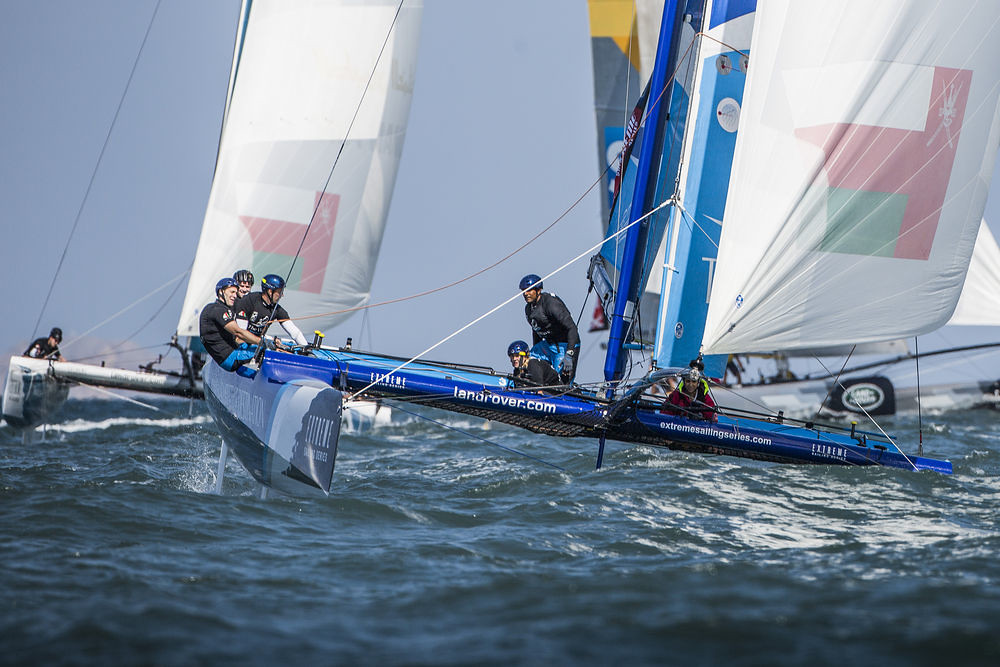
The ocean performance record of trimarans is documented history, not promotional copy. In 1980, Eric Tabarly's trimaran Paul Ricard crossed the Atlantic in just over ten days, breaking a 75-year-old monohull record and establishing that the trimaran hull form could compete at the highest level of transoceanic passage-making. In 2009, Pascal Bidegorry's crew completed the transatlantic crossing in 3 days, 15 hours and 25 minutes at an average of over 32 knots - still the Guinness World Record for sailing transatlantic speed. In 2017, Francis Joyon and crew circumnavigated in under 41 days aboard the trimaran IDEC Sport, confirming ocean-scale endurance across tens of thousands of miles at sustained high speed.
These records were set under racing conditions with pushed crews. Their expedition relevance is what they establish about the hull form's headroom. A trimaran sailing at comfortable passage pace, with guests aboard and no race pressure, still converts wind to forward miles at a rate a displacement motor explorer cannot match without burning through its fuel reserve. In the Atlantic Rally for Cruisers - the world's largest trans-ocean sailing event - trimarans have achieved strong results in the multihull divisions in some editions, though catamarans now represent the majority of multihull entrants by a significant margin and overall results vary from year to year. The ARC nonetheless provides a useful real-world reference for offshore multihull passage performance across a large and diverse fleet.
Passage speed has a direct consequence in expedition planning. Antarctic seasonal windows are finite. If the transit south from Ushuaia takes several days fewer each way on a fast trimaran compared to a displacement motor vessel running at fuel-efficient cruise, that is meaningful additional time in Antarctic waters. Bluewater trimarans project daily runs of over 200 nautical miles in favourable conditions - putting an Atlantic crossing under two weeks at cruising pace, competitive with or faster than a motor explorer trying to preserve its range.
Seakeeping and Motion: What the Passage Actually Feels Like
The persistent objection to multihulls offshore is motion comfort. The data runs contrary to that assumption for trimarans. A cruising trimaran holds a heel angle of five to ten degrees under sail. A monohull sailing upwind in a moderate seaway heels at twenty to thirty-five degrees with continuous roll correction as waves pass beneath the keel. That difference determines whether a meal stays on the table and whether equipment can operate without being secured against the next slam.
The trimaran's righting moment does not peak until thirty-two degrees of heel. Under normal cruising conditions the vessel never approaches that limit - the motion is firm and stable rather than the pendulous rolling that a deep-bodied motor explorer produces in beam swells. Beam swells are perpendicular to the natural routing lines of the Southern Ocean and the North Pacific, which is precisely when motor superyachts roll most heavily and most continuously. The trimaran's wide beam absorbs the same swell without the same amplitude.
The practical accumulation across a multi-week passage matters more than any single sea state. Reduced motion fatigue means guests and crew arrive at the destination ready to dive, photograph, and explore - not recovering from the transit in their berths.
The Silence Dividend
Propeller cavitation and engine vibration from a motoring superyacht transmit underwater noise that disrupts marine mammals. This is the reason whale-watching protocols in sensitive areas require engine shutdown during close encounters, and why Marine Protected Areas in the Galápagos and along the Antarctic Peninsula carry formal noise-impact guidelines for visiting vessels.
A trimaran arriving under sail and anchoring generates no mechanical underwater sound. No cavitation signature precedes it into a bay. No engine idle vibrates through the hull at anchor. The silence is structural, not incidental - a vessel that uses wind rather than propulsion to travel does not produce propulsion noise, and that absence is present from the moment the vessel enters the area, not just during the final approach.
In wildlife-sensitive zones this changes what is observable. Humpbacks do not scatter before the vessel arrives. Penguin colonies are not disturbed during landings. Dive sites retain their acoustic environment. For guests whose primary motivation is wildlife encounter - which describes nearly every client in Antarctica, the Galápagos, or coastal Patagonia - this is a material expedition differentiator. No major expedition charter editorial has framed it as a hull-type comparison, but the marine biology behind it is not subtle.
Shallow Draft, Deeper Access
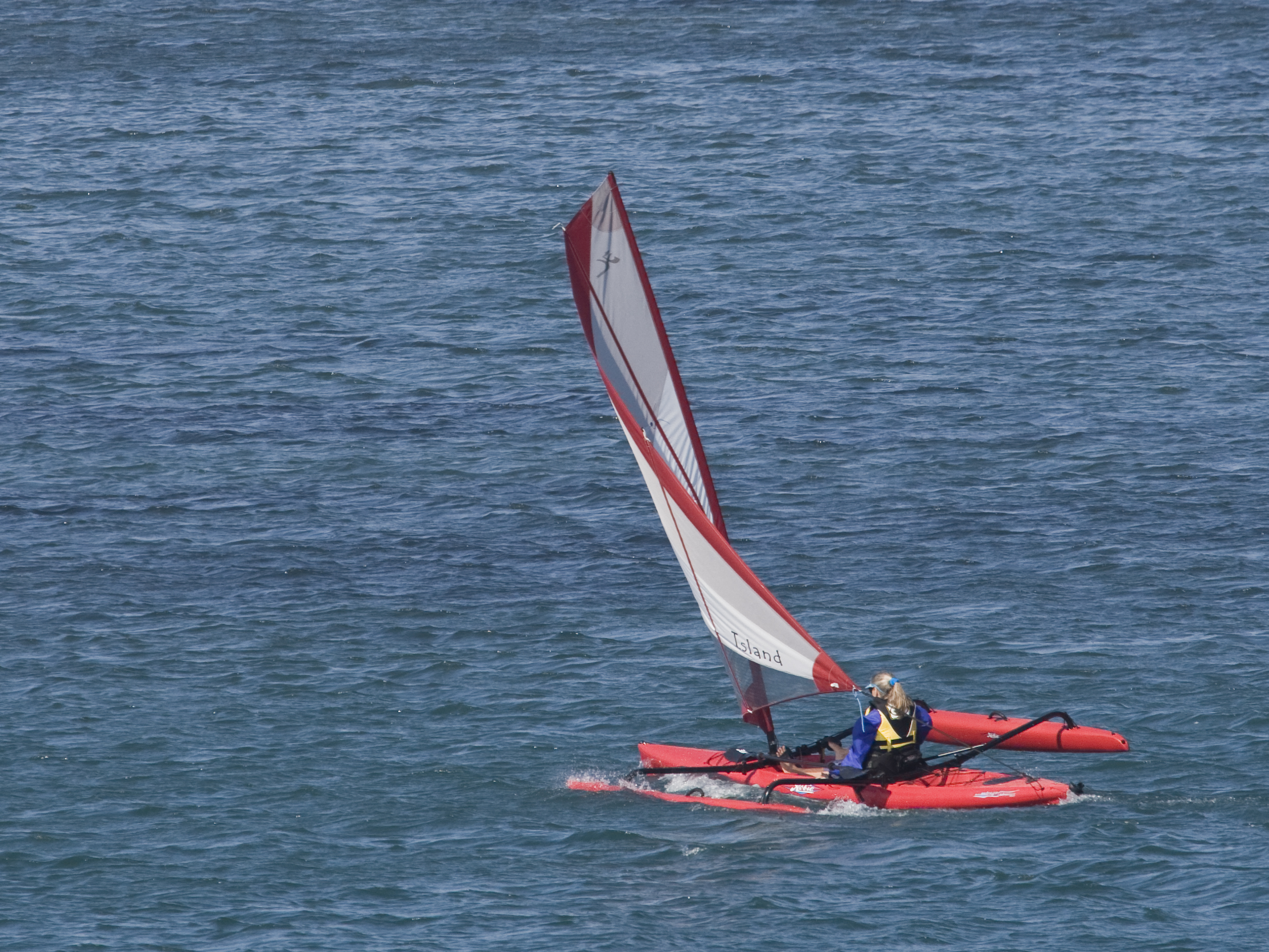
A conventional superyacht's deep fin keel closes off a substantial share of the world's most compelling anchorages. Coral atoll lagoons, Patagonian fjord inlets with shallow rock shelves, polar coastlines with uncharted ground - all require minimal draft to enter. A trimaran carries no deep fin keel. Its draft is a fraction of a comparable monohull, distributed across the full beam rather than in a narrow centreline fin.
- Tuamotu atoll passes with shallow lagoon entries are reachable under a trimaran's draft; a deep-keeled superyacht must anchor offshore or stay outside entirely.
- Glacial bays in Svalbard shoal abruptly toward calving faces - a shallow-draft trimaran can approach where a keel vessel must stand well off.
- Antarctic coastlines are incompletely charted; shallow draft reduces the consequence of contacting uncharted ground and allows tighter manoeuvring when conditions require it.
This is not a marginal operational difference. In polar waters and among outer archipelagos, access is the expedition. A vessel that must anchor a kilometre offshore from a glacier or a seabird colony delivers a fundamentally diminished version of what is possible at that destination.
The CO2 Arithmetic Per Passage
Aggregate fleet emissions figures establish the scale of the industry's footprint - research puts the collective annual CO2 output of the top 300 superyachts at around 285,000 tonnes, with the monthly carbon footprint of a large motor superyacht owner at sea equivalent to roughly fourteen European citizens' full annual output. Those aggregate numbers do not help an expedition client make a vessel-type decision. The per-passage comparison does.
With fuel consumption typically running to tens or hundreds of litres per hour at cruise depending on vessel size and speed, a motor superyacht's ten-day transit to a remote destination is not an abstract environmental concern - it is a concrete volume of combustion output generated in some of the world's most ecologically sensitive waters, before a single day of expedition activity begins. A sail-primary trimaran with fuel-cell electric propulsion changes the arithmetic entirely. The passage runs on wind and stored solar energy. The fuel reserve is held for manoeuvring, not ocean miles. The CO2 output per expedition voyage becomes a point of factual record rather than an offset calculation.
For charter guests voyaging to Antarctica or the Galápagos - environments under active conservation monitoring - the emissions profile of their vessel is part of the expedition's integrity. This is not a reputational nicety. Several Antarctic gateway ports and MPA administrations have begun tracking vessel emissions as part of permit conditions. The direction of travel is clear.
Dragonship Explorer: Engineered for the Expedition Profile
PI Superyachts' Dragonship Explorer is built around the expedition use case rather than adapted toward it. The structural specification targets open-ocean passages in high latitudes. Its 291 square metres of interior living space reflects the space-to-displacement ratio that carbon fibre composite construction makes possible at this scale - a ratio steel-hulled motor explorers cannot approach without weight penalties that directly affect both speed under sail and energy consumption under motor.
The propulsion system integrates fuel cells and solar battery storage for electric drive. The Dragonship Explorer is not a sailing vessel with a diesel backup - it is a genuinely zero-emission expedition platform. Fuel cells produce electricity without combustion. Solar storage supplements that supply across tropical and summer-latitude passages. There is no diesel idle at anchor, no propeller turning on arrival. The silence dividend described above is built into the architecture, not bolted on as an optional feature.
Carbon fibre composite construction also reduces displacement dramatically relative to steel-hulled motor explorers of comparable accommodation volume. Lower displacement improves performance under sail in moderate conditions, and reduces electric drive demand in calms - preserving the energy reserve for genuine contingencies rather than routine windless legs.
Planning Your Expedition Aboard a Sailing Trimaran
Expedition planning on a sail-primary superyacht follows the same seasonal logic as motor expeditions, with considerations that differ in practical ways.
Seasonal windows
- Antarctic operations are viable December through March - the southern summer when sea ice retreats sufficiently for coastal navigation and extended daylight allows safe passage.
- Arctic and Svalbard expeditions run July through September, when ice concentration drops enough for high-latitude transit.
- North Pacific rim destinations - the Aleutians, Haida Gwaii, the outer Kuril Islands - are most accessible May through August, within the summer storm lull.
Structural and classification
- Ice-class notation requirements vary by flag state and classification society - verify current requirements directly with the relevant authority for the specific destination rather than relying on generalised guidance.
- Offshore expedition passages require Category 0 or equivalent stability certification; confirm this from the vessel's formal classification documentation rather than from marketing materials.
- Polar passages should include a dedicated ice-navigation system and a formal ice-pilot arrangement for Antarctic Peninsula and high Arctic transits where classification rules or insurance conditions require one.
Provisioning and autonomy
- Confirm the actual energy and fuel reserve against the expedition's specific motoring contingency - calms, fjord navigation, harbour manoeuvring - rather than assuming theoretical sail range covers every scenario.
- Three to four weeks of provisioning autonomy is realistic for Southern Ocean or high Arctic circuits where resupply is unavailable; verify this against the planned itinerary's actual distance and duration.
- Medical provisioning and evacuation planning scale with distance from coast-guard coverage; a trimaran's faster passage speeds can reduce exposure time in the most remote segments compared to a slower motor vessel.
When commissioning or chartering an expedition-grade sailing superyacht, verify the structural specification against the specific passage profile rather than a general offshore category. Polar waters place demands on hull structure that coastal-specification construction was not designed to meet - ask the yard or broker to specify each element against the actual itinerary, in writing, before the contract is signed.
Frequently Asked Questions
Is a sailing trimaran genuinely stable enough for Southern Ocean conditions?
Yes. A cruising trimaran holds five to ten degrees of heel under sail and its righting moment peaks at thirty-two degrees - a limit that Southern Ocean swells alone will not reach under normal passage conditions. The wide beam that generates this stability also prevents the heavy beam-swell rolling that motor superyachts experience on the same routing, where prevailing swells run perpendicular to the natural course. The motion is firmer and more linear than either a monohull or a deep-bodied motor explorer in comparable sea states.
How does a trimaran handle extended windless legs in remote regions?
An expedition trimaran like the Dragonship Explorer uses fuel-cell electric propulsion rather than a diesel powerplant, so motoring in calms does not carry the same fuel-volume penalty as a conventional motor superyacht. Because ocean miles are covered under sail, the energy reserve available for windless motoring is proportionally large relative to actual demand. Satellite weather routing allows course adjustments that return the vessel to favourable wind before reserves become a planning concern in most scenarios.
Does arriving under sail make a measurable difference for wildlife encounters?
The mechanism is underwater acoustic disturbance, not surface noise. Propeller cavitation propagates sound at a range and frequency that disrupts cetacean communication, navigation, and feeding behaviour - which is why engine-shutdown protocols already exist in sensitive marine areas. Arriving with no engine running eliminates the disturbance entirely rather than reducing it for the final few minutes of approach, a meaningful distinction in areas where undisturbed animal behaviour is the primary draw.
What separates an expedition-grade sailing superyacht from a bluewater cruising trimaran?
The distinction lies in structural specification, systems redundancy, and autonomous range. An expedition-grade vessel is built to offshore structural standards for high-latitude sea conditions, carries redundant navigation and communications, and is provisioned for extended periods without port access. On a sailing trimaran, additional qualifiers include ice-class hull consideration for polar passages, a propulsion system with sufficient stored energy for prolonged windless motoring, and formal offshore stability certification matched to the actual passage profile - not a generic offshore category.
How does the emissions picture affect expedition permitting and charter compliance?
Several Antarctic gateway ports and MPA administrations are moving toward emissions documentation as part of vessel access conditions, and a number of high-value charter clients now require sustainability reporting for corporate travel programmes. A sail-primary trimaran with zero-emission electric propulsion produces a factual emissions record for ocean passages rather than an offset estimate. For operators and guests who need concrete figures rather than approximations, this is a practical advantage that will grow as destination-access rules tighten. Contact PI Superyachts directly for the Dragonship Explorer's current certification and emissions documentation.