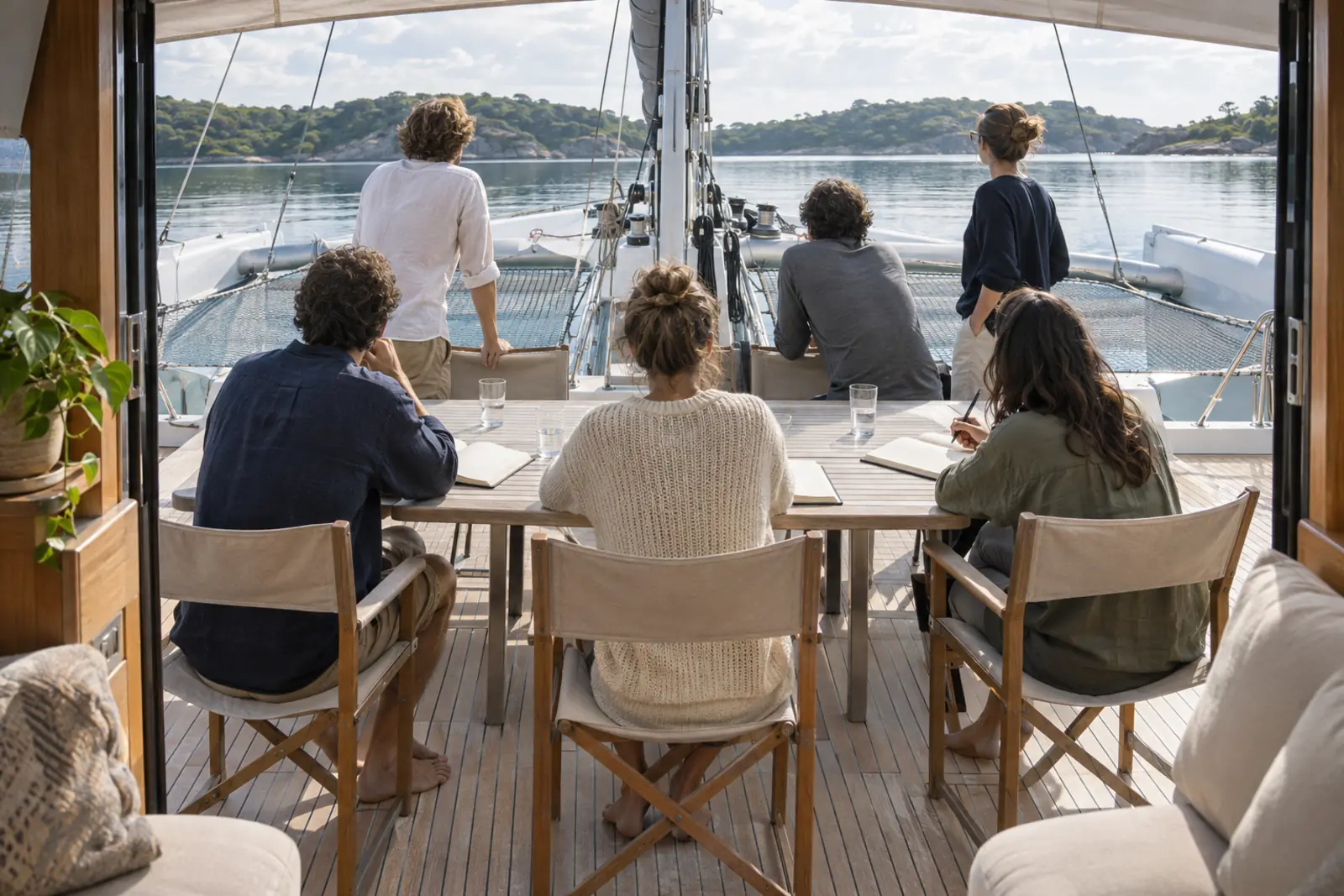
Superyacht charter has long served corporate hospitality, and the super trimaran adds a few things to the picture: a wide, stable deck at anchor, a different sailing experience from a motor yacht, and, depending on how the yacht is run, lower fuel use. For companies planning client events, incentive travel or executive retreats, it is worth understanding what the format does well, where it has limits, and what to ask before committing. This guide covers the types of event that suit it, the practical issues, and the questions to put to a charter broker.
Why Consider a Super Trimaran Over a Motor Yacht for Corporate Events
The default in corporate yacht charter has been the motor superyacht: a floating hotel with predictable scheduling, generous interior volume and crews used to large groups. The comparison with a trimaran is not one-sided, but there are three areas where the multihull format is worth a look.
The first is deck space. The wide beam of a trimaran gives outdoor area that is generous for the yacht's length, which helps when the point of the event is mingling. Wide side decks, a large cockpit and a foredeck or trampoline area give groups natural places to form clusters. Interior volume is different: a motor yacht of the same length usually has more enclosed saloon space, so check the general arrangement drawing if you need indoor seating for everyone.
The second is the experience. A motor yacht at anchor is much like a floating conference room with a view. A sailing yacht underway offers something different: the sound of the rig, the sense of speed, the sight of a performance boat working. Guests who have done the standard charter circuit may find that novel. The trade-off is that sailing schedules depend on wind, so itineraries need more flexibility than a motor yacht's.
The third is fuel use. Corporate governance frameworks increasingly ask event organizers to account for the carbon footprint of hospitality spending. A large motor yacht burns a lot of diesel; a sailing yacht that spends much of its time under sail burns far less. The size of the difference depends on the yacht and the route, so ask for logged consumption figures rather than relying on general claims. Our guide to low-emission sailing explains the issues in more detail.
Types of Corporate Events That Suit a Super Trimaran Charter
Client Entertainment and Relationship Building
The classic use of superyacht charter in business is the relationship-building trip: taking key clients, prospects or partners somewhere beautiful, away from offices and conference halls. A multi-day live-aboard charter gives time for conversations to develop in a way a single dinner cannot, and a different anchorage each evening supplies a new setting without packing and unpacking. Group size is limited by the yacht's overnight berths and by local passenger rules, so confirm both with the broker before inviting anyone.
Product Launches and Brand Activations
A super trimaran is visually distinctive, which suits brands in performance, technology, luxury goods or automotive sectors. A private charter also gives control over who attends and what is photographed. Be realistic about logistics: tender transfers limit how fast guests can board, media crews need space and permission, and filming or commercial activity must be cleared with the yacht's owner or management company and may require specific permits in some jurisdictions. Ask about these in writing at the start.
Executive Retreats and Board Meetings
Time at sea removes many of the usual distractions, which is why some leadership teams use yachts for strategy sessions. Practical matters decide whether it works: a table that seats everyone in the saloon or shaded cockpit, reliable connectivity (satellite internet is usually slower and more expensive than shore broadband), and a schedule that leaves working hours protected from sailing and shore excursions. Ask the captain to describe the connectivity on board and what happens when the yacht is outside coastal coverage.
Incentive Travel for High Performers
Incentive recipients tend to respond to novelty and genuine experience more than to generic luxury. On a crewed sailing yacht, guests can often take the helm under supervision or help with sail handling if they want to, which adds an active element to what would otherwise be a passive trip. Check the yacht's policy on guest participation and on children or guests with limited mobility, and make sure the incentive program's insurance covers the activities involved.
What Size and Type of Super Trimaran Suits a Corporate Group
There is no single best yacht, but group size, event format and itinerary point toward different classes of vessel. Our guide to super trimarans, charter and ownership describes the main classes in more detail.
Larger sailing trimarans in the superyacht range offer the most deck space, the most cabins and the greatest range, which suits larger groups and longer programs. They also cost the most to charter, and the number of such yachts available for charter anywhere is small, so availability in your chosen region and dates may decide the choice.
Mid-sized yachts suit smaller senior groups, where a high ratio of private space per guest matters more than headcount. For a board of six or seven, a mid-sized yacht can create a better atmosphere than a larger one in which the group feels lost.
Expedition-style trimarans open itineraries beyond the standard charter circuits, into remote island groups, but they bring long lead times, complex logistics and a need for evacuation and medical planning that a short Mediterranean event does not. Ask the broker how the yacht handles those requirements.
Destinations for Corporate Super Trimaran Charter
The Mediterranean is the main market for European corporate charter, with a summer season, good port infrastructure and strong food and wine culture. Our Mediterranean guide covers France, Sardinia and Greece, and the Caribbean is the usual choice for winter programs (see the Caribbean guide). Remote regions such as the Indian Ocean and South Pacific are operationally demanding and require longer lead times and careful logistics.
For a corporate group, three destination factors matter most: how close the embarkation port is to major airports, how reliable the weather is in your dates, and how easily a sudden change of plan (a delayed flight, a day of rough weather) can be absorbed. Ask the captain for an itinerary with short passages and a sheltered fallback anchorage for each day.
Onboard Facilities and Event Infrastructure
Corporate events work best when the yacht's facilities are matched to the program in advance. Raise event-specific requirements in the planning stage so nothing is discovered on departure morning.
Catering is usually the first topic. Charter yachts of this size normally carry a professional chef, and corporate groups typically agree a menu program with the chef before the charter begins, including dietary requirements, allergens and any destination-themed meals. Ask how provisioning is handled and whether specialist catering can be brought on board for a larger event.
Audio-visual needs for presentations are generally met by bringing portable equipment or hiring a marine AV specialist. The stable platform of a multihull simplifies setup, but power capacity, shade and wind noise still matter. Check what the yacht already has (screens, sound, generator capacity) and confirm anything extra with the crew before departure.
Tender operations deserve thought. Arriving at a remote anchorage and going ashore for a beach dinner is a highlight, but transfers take time and depend on sea state. For guests who are not physically agile, ask the crew in advance about boarding arrangements.
Sustainability and Corporate Reporting
Many large companies require event organizers to show that supplier choices account for environmental impact. The comparison between a sailing yacht and a motor yacht can be measured, but it should be measured properly: fuel logs for the actual charter period, the same trip distances, and a clearly stated comparison benchmark.
Fuel consumption figures vary enormously with size, speed and sea conditions, so treat any general figure with caution, and ask the management company for the specific yacht's logged consumption. Companies that report emissions should agree the methodology with their own sustainability advisers, since reporting frameworks differ by organization and jurisdiction. Be careful with marketing claims that go further than the data supports, because they can create reputational risk of their own.
Planning a Corporate Super Trimaran Charter
Corporate charters differ from leisure bookings: dates are fixed, guest lists are precise, dietary and accessibility needs can be complex, and there may be media or content components that need coordination with the crew. Starting early is the single most useful step.
A typical process begins with a written brief to a charter broker covering group size, event objectives, preferred regions, target dates and budget. The broker proposes yachts, checks availability with the management company and prepares a charter agreement. Peak-season availability in the Mediterranean in summer, and in the Caribbean from roughly December to April, fills well ahead, so build in a long lead time for fixed event windows. Prices and availability change regularly, so confirm them directly with the broker rather than relying on older figures. Our charter cost guide explains how rates and extras are structured.
A briefing with the captain and chef before departure is worth arranging. Experienced captains can advise on routes that balance sailing with schedule certainty and can point out logistical problems that are hard to see from shore.
Insurance and contracts are more complex for corporate events than for leisure trips. Check that your events insurance covers activities offshore, that any participant waivers comply with the rules of the yacht's flag state, and that media or content activity has been cleared with the owner and charter manager. A marine insurance broker who handles corporate event cover can advise on typical requirements.
Frequently Asked Questions
How many guests can a super trimaran accommodate for a corporate day charter?
It depends on the yacht and the location, because local maritime regulations and the yacht's passenger certification set the maximum number of people on board. Overnight capacity is set by the number of berths and is usually much lower than the day-charter limit. Confirm both figures, and the rules at your chosen destination, with the broker before you plan the guest list.
Can a super trimaran be fitted with AV equipment for presentations and product launches?
Often, yes, with planning. Many large yachts have generators, shore power connections and saloons or shaded decks that can host screens and sound systems, and marine AV specialists can supply extra equipment. The stable platform of a multihull makes setup easier than on a heeling monohull. Ask the crew what is already on board and what has to be brought in.
How far in advance should a company book a super trimaran for a corporate event?
For peak seasons, such as the Mediterranean in summer or the Caribbean in winter, plan many months ahead and ask the broker for a realistic lead time for your chosen region. Shoulder-season dates can sometimes be arranged at shorter notice. Groups with fixed event dates should start the conversation as early as possible.
Is a super trimaran stable enough for guests who are not regular sailors?
A wide beam provides good stability at anchor, which suits guests who rarely spend time afloat. In open water any sailing yacht moves, though a trimaran generally heels less than a monohull of similar length. A captain can plan routes with short passages and sheltered anchorages for groups with limited sea experience; tell the broker in advance if guests are prone to seasickness.
What catering standards can corporate groups expect on a charter yacht?
Crewed charter yachts of this size normally carry a professional chef, and corporate groups usually agree a menu program in advance. Menus can range from casual deck lunches to formal multi-course dinners. Dietary requirements, allergens and any themed menus should be discussed with the chef at the planning stage.
Can the fuel savings from sailing be included in corporate sustainability reporting?
They can, if the data supports it. Fuel logs from the yacht allow a comparison against a stated benchmark, but the methodology should be agreed with your own sustainability advisers, as reporting frameworks vary. Avoid claims that go beyond what the logs show.
If you are weighing a corporate event on a super trimaran, a good next step is to compare options in our guides to trimarans versus monohull superyachts and how charter works, then brief a charter broker with your group size, dates and event goals.