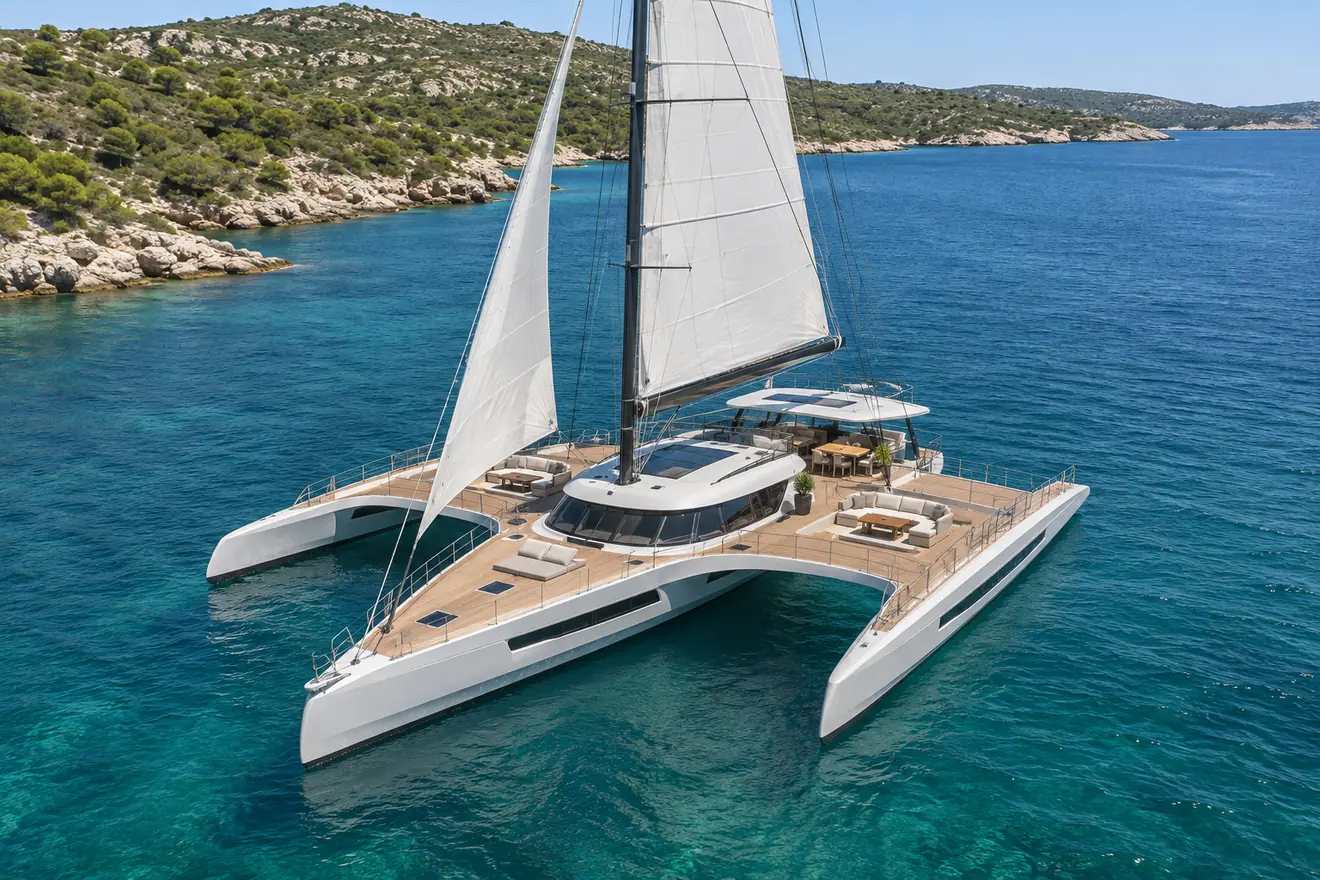
A super trimaran is a large, professionally crewed yacht with three hulls: a long central hull and two slim outer hulls (amas) joined to it by crossbeams. There is no formal definition of "super", but the word is normally used the way it is for superyachts, for vessels generally from 40 meters (130 feet), and sometimes from 24 meters (79 feet). The three-hull layout is why these yachts heel less under sail, carry wide decks and move efficiently. This guide explains how they differ from monohulls and catamarans, how charter works, what buying a used one involves, and what to check before committing.
What Is a Super Trimaran and How Is It Different?
Most yachts are monohulls: one hull cutting through the water. A trimaran has three, a long central hull flanked by two smaller outer hulls, called amas or floats. In the Polynesian terms that sailors borrow, the central hull is the vaka, each float is an ama and each crossbeam is an aka, according to the Wikipedia article on trimarans.
"Super" follows the yacht-industry shorthand for large, high-end vessels. According to Wikipedia's superyacht entry, there is no official definition: superyachts are generally 40 meters (130 feet) or longer, though the term is sometimes stretched down to 24 meters (79 feet). A super trimaran is therefore a trimaran of that scale, crewed by professionals and built for guests rather than for racing alone.
Stability
The three-hull layout gives a trimaran a wide base of support. Under sail, a trimaran generally heels far less than a monohull of similar size, and at anchor it is typically less prone to the rolling that can make a night on a monohull uncomfortable. Stability is not unlimited: sea state, wind and how the boat is loaded all matter, and a trimaran can still pitch and move in a short chop. But for guests who dislike motion, the difference is real and is one of the main reasons people look at the type.
Efficiency
Slender hulls generate less drag than the broad, deep hull of a displacement monohull, which is why trimarans have a long record in offshore racing. The 90-foot (27 m) trimaran USA 17 won the 2010 America's Cup. For a cruising yacht this can mean good speed from modest sail area and lower fuel use when motoring at moderate speed. How much you actually save depends on the specific design, its weight and how it is used, so ask for performance and consumption data for the individual yacht. The speed and performance guide goes further into what to expect.
A different silhouette
A super trimaran looks unlike a conventional yacht: wide, low and purposeful. That presence is a matter of taste, and it comes with practical consequences for dockage, covered under trade-offs below.
Super Trimaran vs Yacht: Trimaran, Catamaran or Monohull
People searching for "super trimaran vs yacht" usually mean a conventional monohull yacht, but the real choice is often between three layouts. In short:
- Monohull - one hull and usually ballast for stability. Berths, yards and surveyors are plentiful, and interior volume is concentrated in a single deep hull. It heels under sail and can roll at anchor.
- Catamaran - two hulls set apart. Stability comes from the distance between the hulls, and the wide platform gives a lot of cabin and deck area. It is the most common large multihull, so there are more yachts and berths to choose from.
- Trimaran - one long central hull plus two floats. The central hull carries most of the load, the floats add sideways stability, and the long slender form favors speed and efficiency. Interior volume is distributed differently, and the type is rarer.
The comparison guides go into each pairing: super trimarans compared with monohull superyachts and trimaran vs catamaran superyachts.
Space, Stability, and the Experience
Numbers aside, what matters is how it feels to be aboard, and this is where the design pays off for many guests.
Deck and living space
The wide beam of a trimaran creates deck and living area that is generous for the boat's length. Large outdoor lounging and dining areas are common, and many designs add trampoline netting between the hulls. Interior volume is a more mixed picture: the outer hulls are slender, so cabin and storage space is often distributed differently than on a monohull or catamaran. Deck plans and cabin layouts vary a great deal between builders, so compare actual general arrangement drawings rather than assuming.
Comfort underway and at anchor
Because a trimaran sails with a small heel angle, ordinary life aboard (a meal at the table, a drink on deck, sleeping while moving) tends to be easier than on a heeling monohull. Guests can stay on deck, the galley keeps working and a cabin that stayed calm overnight makes for an easier morning. The effect is strongest in moderate conditions. Anyone prone to seasickness should still bring their usual remedy and talk to the captain.
Built for real journeys
Many large trimarans are designed for genuine cruising and some for expedition-style travel. Range, storage, systems redundancy and crew accommodation differ widely, so judge each yacht on its own specification and track record. The comparison of expedition trimarans and motor explorers looks at this question in more depth.
Trade-offs to Know About
A trimaran is not simply a better yacht. Three issues come up in every honest comparison.
Berthing and haul-out
Wide hulls need wide berths, and the Wikipedia trimaran article notes that the complex geometry makes docking more difficult than for a catamaran or monohull. Confirm in advance that your intended harbors and shipyards can take the yacht's beam.
Capsize behavior
The floats give high sideways stability, so trimarans tend to fail by pitchpoling (tipping end over end) rather than by rolling, according to the same trimaran article. For a crewed yacht this is managed by sailing conservatively and reducing sail early, which is a reason to value an experienced multihull captain.
Cost, availability and specialists
Trimaran hull structures are more complex than a monohull's, and the used market is small. Specialist yards and surveyors are fewer than for monohulls, so expect to look harder for a suitable yacht and for people who know the type.
Size and Type Classes of Super Trimaran
Super trimarans are not one product. They fall broadly into a few classes, and knowing which you are looking at helps you ask better questions.
Large sailing trimarans
At the top end are large sailing trimarans in the superyacht size range, built to carry guests and crew over long distances. They offer the most deck and cabin space, the greatest range and the highest running costs, and they need berths and shipyards that can handle a very wide hull. Expect crew of several people and a long list of systems to maintain.
Expedition and explorer trimarans
Explorer-style trimarans, sail or power, are built for remote cruising: more fuel and water, stronger construction, space for tenders and equipment, and often more redundancy in key systems. They suit owners who want to go beyond standard charter routes, but they are specialist vessels, and their real-world capability should be checked against actual passage history.
Smaller and more accessible trimarans
Below superyacht size there are smaller trimarans that bring the same wide-base stability to a more manageable package. They are cheaper to run and easier to berth, and some can be trailered or folded for transport. Space and range are naturally more limited, and they are usually run with a small crew or by the owner.
Sail, power or hybrid
Propulsion is a separate axis: sailing trimarans rely on the rig, power trimarans use engines (the slender hulls can allow good efficiency at moderate speeds), and hybrid or electric-assisted systems are increasingly offered. Ask what the yacht actually uses on a typical passage and what the fuel burn is at cruising speed. The guide to low-emission sailing and trimaran charter looks at what is realistic. Treat brochure efficiency claims as a starting point and ask for logged consumption.
Chartering: Try Before You Commit
If you have never been aboard a super trimaran, a charter is the most practical way to find out whether the type suits you. The guide to how super trimaran charter works covers the process step by step, and the charter cost guide explains how rates and extras are structured.
What a charter involves
A crewed charter puts you aboard for a set period without the commitment of ownership. The captain and crew handle navigation, safety, hospitality and logistics. Large yachts are usually chartered through a broker, who matches the yacht to your group, dates and region and handles the charter agreement with the yacht's owner or management company. Few trimarans of this size are available for charter, so availability by region and season is often the limiting factor. Regional guides cover the Mediterranean, the Caribbean and French Polynesia.
A taste of ownership
For anyone weighing whether to buy, a few days aboard says more than a brochure about how the space, the motion and the lifestyle suit you. Ask the broker whether the yacht is similar to the one you are considering, and talk to the captain about running costs and maintenance as well as scenery.
Special occasions and escapes
A charter also stands on its own: a milestone celebration, a family gathering, a corporate event or simply an escape to a beautiful coastline. There are separate guides to honeymoon and wedding charters, family charters with children and corporate and incentive charters.
Ownership and Brokerage
Ownership gives you a yacht that is available when you are, set up to your taste, and yours to use as you like, at the price of significant ongoing cost and responsibility. The guide to buying or selling a used super trimaran explains how brokerage works, and the ownership costs guide covers crew, maintenance and charter management.
The case for ownership
Owning a yacht makes sense for people who will spend real time aboard. Annual running costs are commonly quoted as a percentage of the purchase price, so budget for crew, insurance, berthing, maintenance, refit and fuel before you commit, and ask a broker or an experienced owner for current figures.
New build or used
There are two roads in: commissioning a new build or buying an existing yacht through a broker. A new build takes years and gives you control over design and specification. A used yacht is available sooner and its history can be inspected, but condition, equipment age and fit to your needs vary. The right path depends on timeline, budget and how bespoke you want the boat.
Guidance through the process
Buying a yacht is a significant decision, and independent advice matters. A typical purchase involves a broker, a marine surveyor, a maritime lawyer and an insurer. Ask who represents whom, how commissions work, and whether the survey and sea trial are carried out by people independent of the seller.
Refit history and inspection records
A well-maintained yacht can serve for decades, but only if maintenance is funded and systems are kept current. When comparing yachts, ask about refit history, hull and rig inspection records and the age of major equipment.
Choosing the Right Yacht
Whether you are chartering or buying, a few things guide the choice.
- How you will use it - relaxed cruising, entertaining, long-range exploration, or all of the above.
- Size and space - the room you need for your guests and the way you like to travel.
- Berthing - whether the harbors and yards you plan to use can accept the beam.
- The experience you want - a charter to sample the lifestyle, or ownership for the freedom of having your own.
- Independent advice - a broker, surveyor or captain with experience of multihulls specifically, not just yachts in general.
The super trimaran sits at an interesting intersection: space and stability that make time aboard comfortable, hull efficiency, and a design distinctive enough to stand apart in any harbor. It prizes the experience of being on the water over sheer size for its own sake. Weighing that against the trade-offs above is the point of this guide.
Frequently Asked Questions
What is a super trimaran, and how is it different from a regular yacht?
A super trimaran is a large yacht with three hulls, a central hull flanked by two smaller outer hulls, rather than the single hull of a monohull. The wide base gives it good stability and generous deck space, and the slender hulls reduce drag. In practice it heels less than a comparable monohull under sail and offers more outdoor living area for its length, though interior layouts and berthing needs differ.
What is a trimaran?
A trimaran is a multihull with a main hull and two smaller side floats joined by crossbeams. Most are recreational or racing sailboats, and some are ferries or warships. A super trimaran is simply a very large, crewed one in the superyacht size range.
Why are trimarans so stable?
The three-hull layout spreads support across a wide footprint, which sharply reduces heeling and rolling compared with a monohull. The result is a yacht that stays closer to level under sail and at anchor in moderate conditions. Stability still depends on sea state, loading and design, so ask the captain or builder how a specific yacht behaves.
Is a trimaran better than a catamaran?
Neither is better in every respect. A catamaran usually offers more interior volume and is more common, with more yachts and berths available. A trimaran favors speed, efficiency and a long slender hull, and is rarer and harder to dock. The right one depends on how you will use the yacht.
Should I charter or buy a super trimaran?
Chartering lets you experience the type without committing, and it is a sensible test of whether the lifestyle suits you. Ownership makes sense when you expect to use the yacht often and can fund crew, maintenance and berthing. If you are unsure, charter first and talk to the captain about real running costs.
How do I go about buying a super trimaran?
There are two main routes: commissioning a new build or buying an existing yacht through a broker. The right path depends on your timeline, budget and how bespoke you want the boat. Use an independent surveyor and a maritime lawyer, and read the guide to how brokerage works before you start.
Are super trimarans good for long journeys?
Many are designed for long-distance cruising, thanks to good speed, stability and deck space, but capability varies by design. Check range, fuel and water capacity, crew accommodation and the yacht's actual passage history rather than relying on the type alone.
Where to Go Next
A super trimaran offers a particular blend of stability, space, efficiency and distinctive style, with real trade-offs in berthing, availability and cost. To keep reading, start with the guide to how super trimaran charter works, the explanation of buying or selling a used super trimaran, and the comparison with monohull superyachts. If you have a question or a correction for the guide, you can send it here.